 PlantFun
Plant Needs
Characteristics
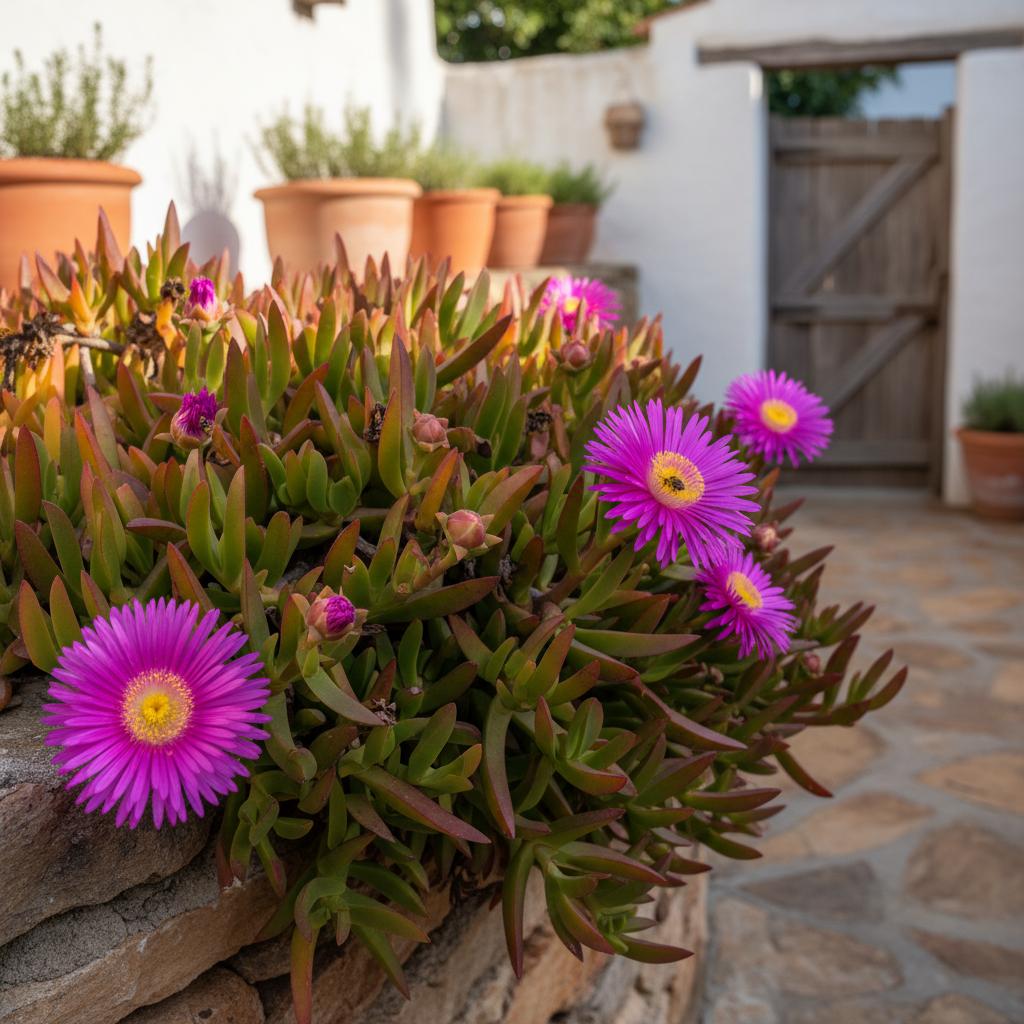
- Leaves: Succulent, opposite, sharply three-angled (saber-shaped), glaucous green, often tinged red or purple at the margins;
- Flowers: Solitary, large (up to 12 cm across), bright magenta to purplish-pink with numerous linear petals and a center of yellow stamens;
- Stems: Robust, trailing, rooting at the nodes to form dense, extensive mats;
- Fruit: Fleshy, indehiscent, edible berry-like capsule.
Care Guide
Water deeply but infrequently, only when the soil is completely dry.
Apply a light, low-nitrogen fertilizer to encourage blooming.. Requires very little fertilization; over-fertilizing can cause excessive foliage growth at the expense of flowers.
Banana Peel Tea:Steep chopped banana peels in water for 24-48 hours, dilute 1:1 with water, and apply to the soil to encourage vibrant blooming. Discard peels in compost to avoid attracting pests.- Containment: Prune back aggressive trailing stems after flowering to keep the plant within its designated area;
- Cleanup: Remove dead or rotting leaves underneath the mat to improve air circulation and prevent fungal issues;
- Deadheading: Remove spent flowers to maintain a tidy appearance, unless you wish to harvest the fruits.
Toxicity
Warning: this plant may be toxic.
Pets: Non-toxic to cats per ASPCA guidelines for the Aizoaceae family.
Humans: Non-toxic to humans; the fruits are edible and leaves are sometimes used in traditional remedies.
Garden Uses & Culture
Culture: Introduced to Europe, California, and Australia in the 19th and 20th centuries for coastal dune stabilization, it has become a familiar, albeit sometimes invasive, sight along Mediterranean-climate coastlines.
Usage: - **Ornamental**: Used as a drought-tolerant groundcover in xeriscaping and coastal gardens; - **Erosion Control**: Planted on sandy slopes and dunes to stabilize soil with its extensive root system; - **Culinary**: The fleshy fruits (sour figs) can be eaten raw or made into traditional jams and preserves.