 PlantFun
Plant Needs
Sunlight
Requires bright, indirect light or dappled sunlight; direct midday sun can scorch leaves.
Watering
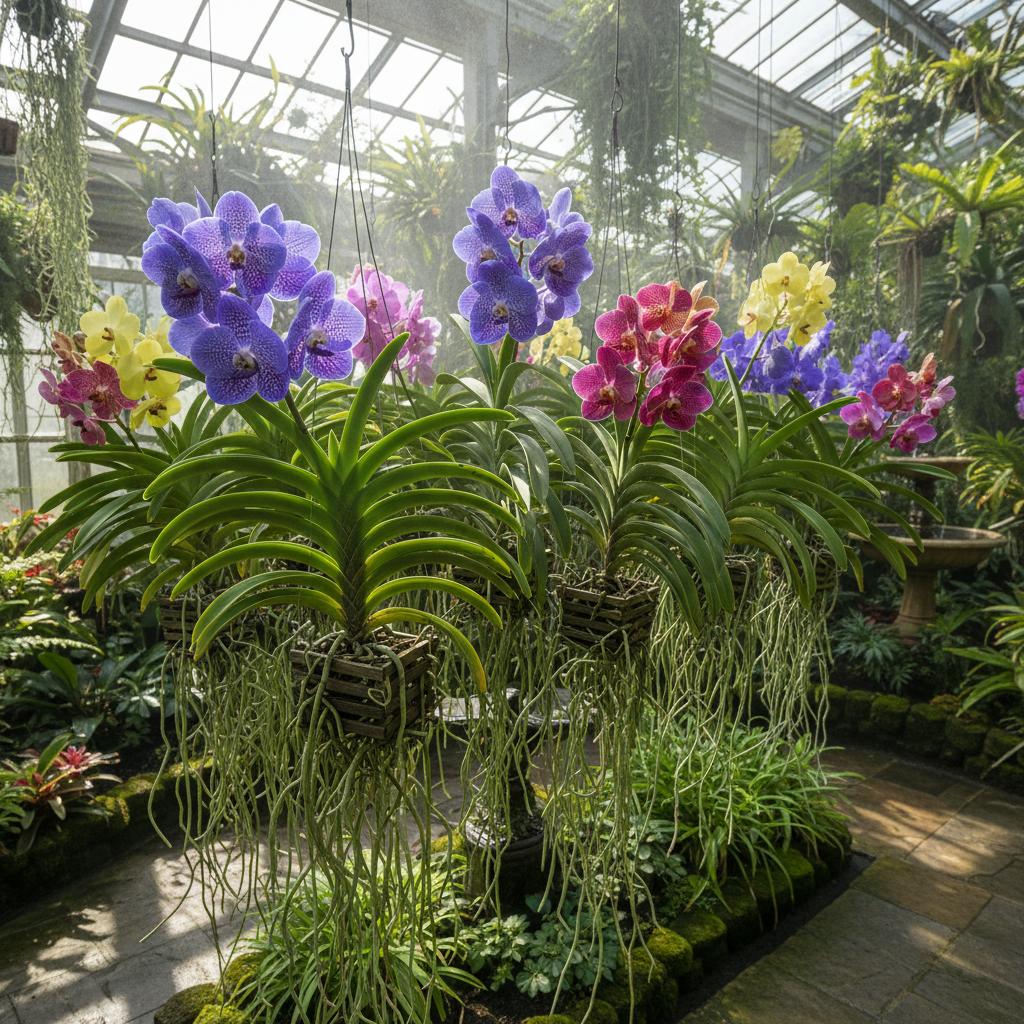
Requires high humidity and frequent watering, often daily if grown bare-root in wooden baskets.
Temperature
Prefers warm days and cooler nights to trigger blooming.
Characteristics
- Leaves: Leathery, strap-shaped, distichous (arranged in two rows), apically unequally bilobed, 10-25 cm long;
- Flowers: Large, up to 10 cm across, pale to deep blue with prominent darker blue tessellations (checkered patterns), borne on an erect to arching inflorescence;
- Roots: Thick, fleshy aerial roots covered in silvery velamen, adapted for clinging to bark and absorbing atmospheric moisture;
- Stem: Monopodial, robust, climbing or erect, becoming woody at the base over time.
Care Guide
Watering
Water daily if grown bare-root, ensuring roots turn green and saturated.
Fertilization
Apply balanced orchid fertilizer weekly at quarter strength.. Vandas are heavy feeders; regular weak fertilization is key to robust blooming.
Banana Peel Tea:Soak chopped banana peels in water for 48 hours, strain, and dilute 1:1 with water. Spray onto aerial roots to boost blooming. Avoid leaving residue on leaves to prevent fungal issues.Pruning
- Remove spent flower spikes at the base using sterilized shears;
- Trim dead, papery, or hollow roots;
- Never cut healthy green or silvery aerial roots, as they are vital for the plant's survival;
- Remove yellowing or naturally senescing lower leaves only when they detach easily.
Toxicity
Warning: this plant may be toxic.
Pets & Humans
Pets: Non-toxic to cats per ASPCA guidelines.
Humans: No known toxicity; generally safe for humans.
Garden Uses & Culture
Culture: Highly prized in Victorian England orchid collections; its discovery sparked a "blue orchid" craze among European horticulturists and elite collectors.
Usage: Ornamental cultivation, greenhouse displays, and extensively used in hybridization to introduce blue and purple genetics into other orchid lines.