 PlantFun
Plant Needs
Characteristics
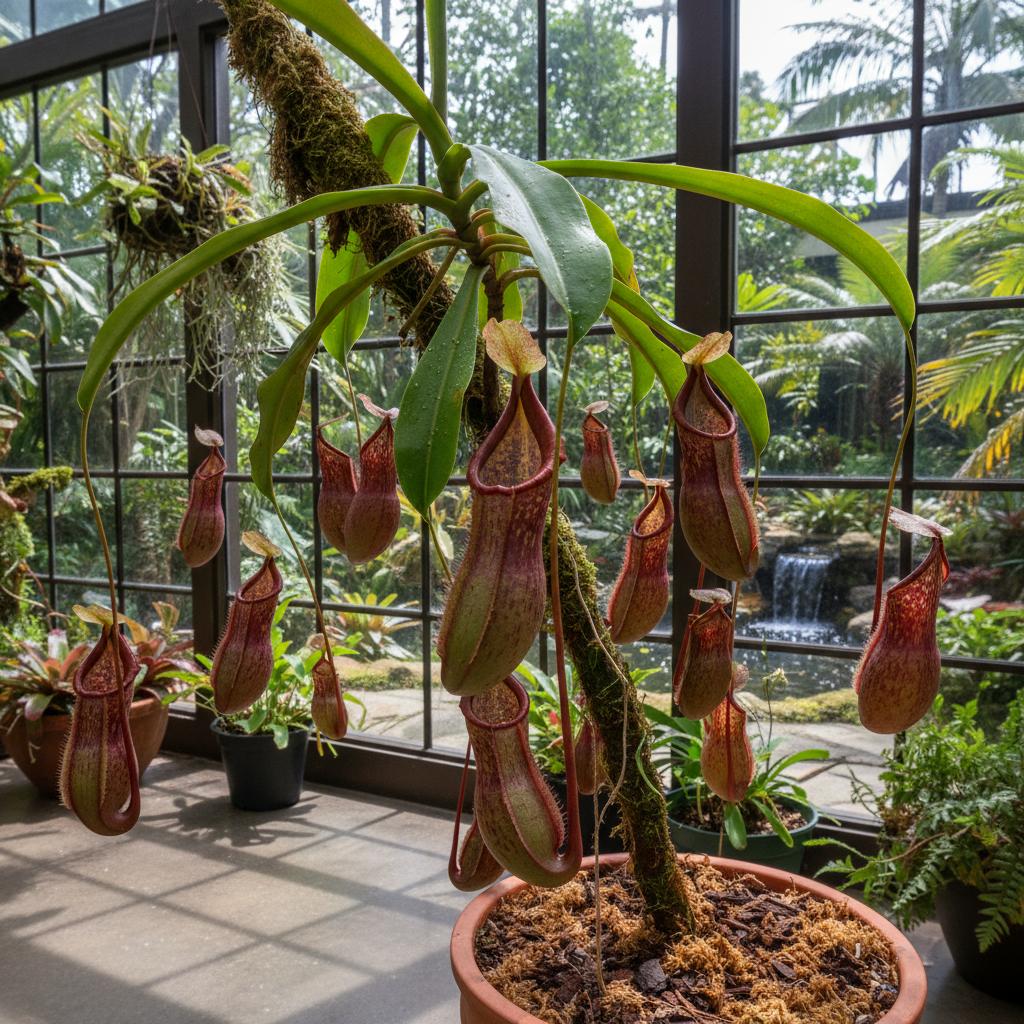
- Leaves: Coriaceous, petiolate, lanceolate to spathulate, up to 50 cm long, with a tendril at the tip that develops into a pitcher;
- Pitchers (Lower): Bulbous and squat, heavily speckled with dark red or purple, featuring prominent fringed wings down the front;
- Pitchers (Upper): Funnel-shaped, elegant, usually lighter in color or yellowish-green, with wings reduced to narrow ribs;
- Flowers: Racemose inflorescence, dioecious, bearing small brownish-red to purplish tepals without petals;
- Stem: Climbing, cylindrical, often glabrous but sometimes covered in sparse, short brown hairs.
Care Guide
Water frequently to keep the sphagnum moss evenly moist at all times; never let it dry out completely.
Do not apply traditional root fertilizers. Allow the plant to catch insects naturally.. Carnivorous plants derive nutrients from trapped prey. Soil fertilization will burn the roots and kill the plant.
Weak Black Tea Spray:Steep a used black tea bag in 1 gallon of distilled water until very faintly colored. Use as a light foliar spray to provide trace acidity and tannins. CAUTION: Never apply standard compost, fruit peels, or food scraps to the soil, as rich nutrients will burn the roots and kill carnivorous plants. Rely primarily on natural insect capture.- Trim off dead or browning pitchers and leaves at the base of the petiole to prevent fungal growth;
- Prune the main climbing stem if it becomes too leggy, which can encourage the growth of basal shoots;
- Do not cut off pitchers that are only partially brown, as the green parts still photosynthesize.
Toxicity
Warning: this plant may be toxic.
Pets: Non-toxic to cats (per ASPCA guidelines for Nepenthes species).
Humans: Non-toxic to humans, though the digestive fluids inside the pitchers should not be ingested.
Garden Uses & Culture
Culture: Discovered by Dr. William Jack in 1819 and named in honor of Sir Stamford Raffles, it became a highly prized specimen in Victorian England's exotic plant collections.
Usage: Cultivated as a striking ornamental plant in botanical gardens, specialized greenhouses, and by carnivorous plant enthusiasts.